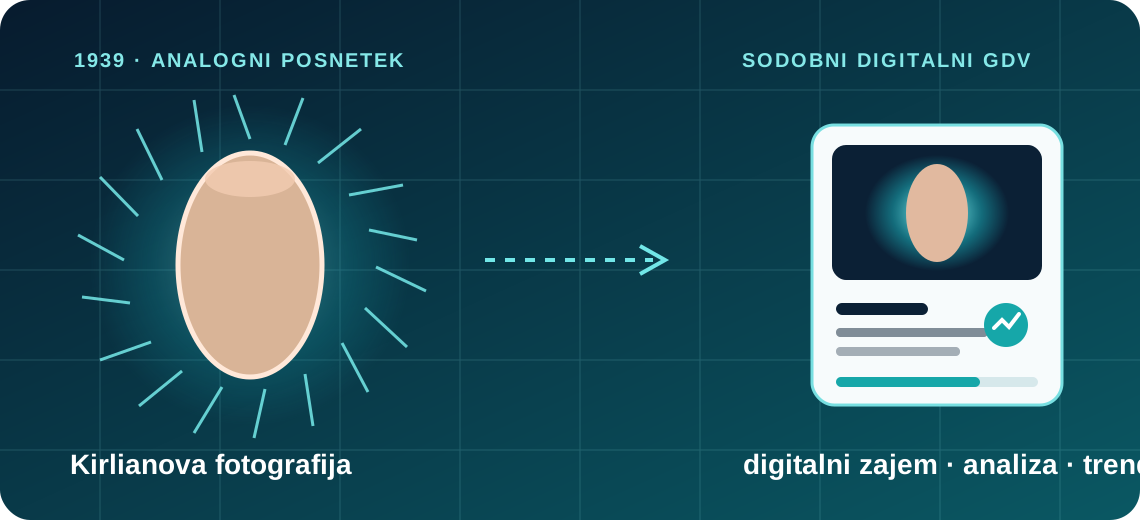
Why the terminology becomes confusing
People often search for “GDV camera”, “Bio-Well software”, “EPI analysis” or “Kirlian photography” as if they referred to one identical technology. In practice the words operate at different levels: a product brand, an imaging method, an analysis tradition and a historical technique.
Bio-Well is a product ecosystem
Bio-Well is a commercial system consisting of dedicated hardware and official software. The camera captures electro-photonic images and the software analyses and interprets the data within the Bio-Well workflow. Current official Bio-Well documentation describes a subscription-based software environment and the Bio-Well 3.0 device as the latest hardware generation.
When someone searches for Bio-Well software, the most direct result should therefore be the manufacturer's official software. Independent tools such as GDV Studio should identify themselves clearly as independent analysis environments rather than official Bio-Well products.
GDV describes a visualization approach
GDV stands for Gas Discharge Visualization. The basic physical event is a gas or corona discharge created around a subject under a high electric field. A digital camera captures the emitted light pattern and software calculates geometric and intensity-based features.
The physical discharge is measurable. The harder question is what a particular image feature means physiologically. That is why serious analysis must separate the directly measured image from statistical associations and from interpretive models.
EPI is closely related terminology
EPI, or Electro-Photonic Imaging, is a term often used for later digital implementations of the same general family of electro-photonic discharge imaging. In practice, publications and commercial systems may use GDV and EPI with overlapping meanings. The exact algorithms and interpretation models still depend on the specific system.
Kirlian photography is the historical precursor
Kirlian photography refers to high-voltage corona imaging popularised in the twentieth century. Early images were often produced on photographic materials and were strongly influenced by moisture, pressure, electrical parameters and the environment. Modern digital GDV/EPI systems add controlled capture, calibration, digital image processing and repeatable numeric analysis.
What does the software actually calculate?
Depending on the system, image analysis can include area, intensity, contour length, form coefficient, entropy-related measures, inner and outer radii, asymmetry, continuity, local gaps, streamers and texture. Some software then maps angular finger sectors to organs or systems. That sector mapping is an interpretation layer, not a direct image of an organ.
Where does GDV Studio fit?
GDV Studio is an independent Windows application developed by PICALLW. It supports direct capture with Bio-Well 2.0 and Bio-Well 3.0 and can open original BDF measurements for local analysis. It adds a strong focus on image morphology, capture quality, repeated measurements, personal baseline, longitudinal comparison and optional HRV/ECG context.
GDV Studio is not affiliated with Bio-Well; Bio-Well 2.0 and 3.0 compatibility refers to direct capture support tested by PICALLW.
How to read claims responsibly
A useful hierarchy is: physical measurement → calculated image feature → observed statistical association → interpretive hypothesis. Problems begin when the last step is presented as if it were the first. This distinction is especially important in health-related contexts.