Why one field app is useful
Building automation systems are heterogeneous. A plant room can contain a BACnet controller, Modbus meters, KNX room devices, M-Bus energy meters and an OEM HVAC controller on the same project. Carrying a laptop remains necessary for some tasks, but a phone can remove a surprising amount of friction during first-line diagnostics.
BACnet: discovery is only the beginning
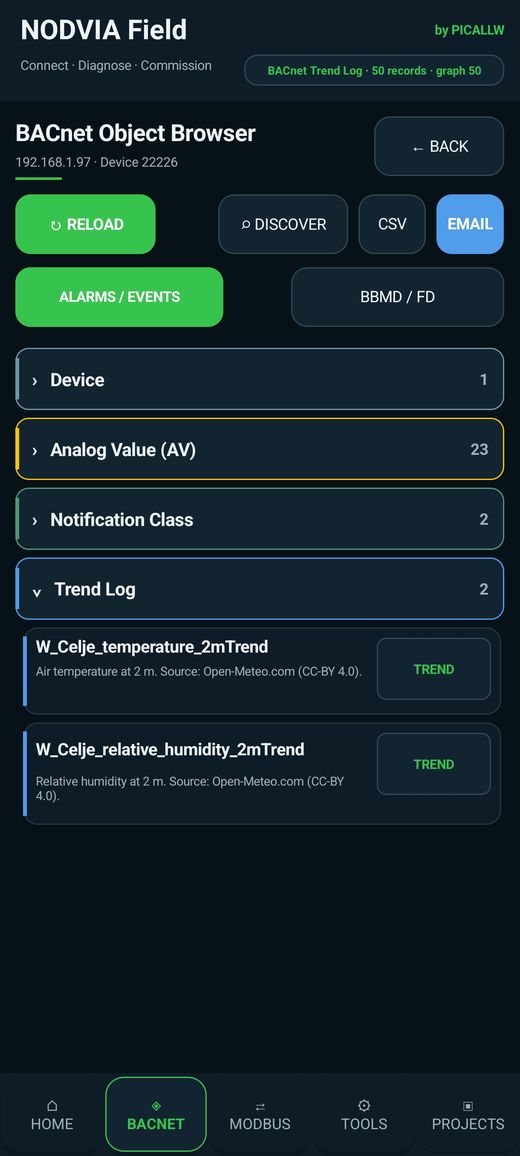
A useful BACnet field tool should perform Who-Is/I-Am discovery, show Device ID and network context, browse objects and properties, read present values and expose enough diagnostic information to distinguish an IP problem from a BACnet problem. For supported writable objects it should also make writes deliberate and visible rather than hiding BACnet priorities.
Across subnets, BBMD and Foreign Device Registration become part of the job. That is why a real field workflow needs more than a list of discovered devices.
Modbus: the value is meaningless without context
Modbus is simple at the protocol level but error-prone in practice. The technician needs slave or Unit ID, function code, register address, 0-based versus 1-based addressing, data width, signedness, byte order, word order, scaling and units. A good app should make those assumptions explicit.
KNX: project context matters
KNX diagnostics becomes far more useful when group addresses, datapoint types and ETS project information are available. Reading a raw telegram is one thing; knowing that group address 2/1/17 represents a room temperature or valve command is another.
M-Bus: commissioning energy meters in the same workflow
M-Bus is common around heat, water and energy metering. A field tool can help with primary or secondary addressing, meter discovery, telegram reading and a quick sanity check before data is handed over to the BMS or energy-management system.
Why specialised tools matter
Real service work often extends beyond the four headline protocols. Siemens Climatix controllers may need a SCOPE-oriented service view; Siemens EM1 modules benefit from device-specific discovery and setup; S7, OPC UA and MQTT appear in mixed automation projects. The value of an integrated toolkit is not that all protocols become identical, but that the engineer can keep project context in one place.
Network discovery and local web interfaces
mDNS, LAN scanning, ping and IP information can answer the question that comes before protocol diagnosis: is the device actually reachable and on the expected network? A local web browser is useful because many controllers expose configuration pages alongside their automation protocol.
Projects, favourites and reports
Discovery becomes more valuable when results can be stored as project data. Device names, addresses, favourite points and notes should survive the end of the service visit. Reports and exports then provide a handover trail rather than a collection of screenshots.
Field app vs dedicated protocol scanner
A specialised scanner can be excellent for one protocol and may expose deeper protocol-specific diagnostics. A multi-protocol field app trades some of that narrow specialisation for continuity across systems. The right choice depends on whether the task is deep protocol analysis or everyday commissioning across many device families.
Where NODVIA Field fits
NODVIA Field is an Android building-automation app for BACnet, Modbus, KNX and M-Bus field work, with Siemens Climatix SCOPE tools plus S7, OPC UA and MQTT support. It is designed for system integrators, service technicians, commissioning engineers and maintenance teams. Supported write operations remain dependent on the protocol, point and project configuration.
Protocol references
- BACnet International – About BACnet
- Modbus Organization – specifications and implementation guides
- KNX Association – KNX Specifications